Picture this: it’s 8:15 p.m., pajamas half-on, and your kid just remembered they’re “starving.” The bedtime spiral starts again — lights, protests, delay. You’ve even Googled bedtime routine for kids printable at midnight, hoping a simple chart could save tomorrow. Been there.
Here’s the thing: without a predictable wind-down, kids’ brains stay on high alert; yours too. Bedtime drifts later, mornings get rushed, and everyone pays — cranky behavior, poor focus, and zero grown-up time. Sound familiar?
By the end, you’ll have a simple, science-backed plan tailored to your home, plus bedtime routine for kids printable charts by age. We’ll map sleep needs, give you a step-by-step, and scripts for pushback. Ready to trade chaos for calm?
Why Bedtime Routines Work: The Sleep Science
Why does a simple, repeatable bedtime routine calm chaos so fast? Here’s the thing: the brain loves prediction. When cues line up — bath, story, lights — cortisol drops, melatonin rises, and kids shift from wired to sleepy.
The science is straightforward but powerful. Circadian rhythm sets the ideal window. Sleep pressure (the homeostatic drive) builds across the day. A consistent routine becomes a cue stack that tells the body, “It’s time.” According to the American Academy of Sleep Medicine, stable schedules improve sleep onset and consolidate nighttime sleep for school-age children.
| Mechanism | What Routine Does | Impact On Sleep |
|---|---|---|
| Circadian Rhythm | Locks a consistent lights-out window | Faster sleep onset |
| Sleep Pressure | Prevents late naps and sugar spikes | Reduced bedtime restlessness |
| Cortisol Regulation | Uses calm cues (dim light, quiet) | Lower arousal and fewer protests |
| Classical Conditioning | Pairs steps with sleep predictably | Kids fall asleep with fewer prompts |
| Light Hygiene | Limits blue light before bed | Stronger natural melatonin pulse |
Picture this scenario: you start bath at 7:15, read at 7:40, lights at 8:00. Night one takes 30 minutes to settle. By night five, it’s 12. Week two? They’re yawning by the first page — not magic, but reliable cues training a faster wind-down.
💡 Pro Tip: Keep bedtime within a 20–30 minute window nightly and begin a “digital sunset” one hour before lights-out; AAP guidance notes screens can delay melatonin release.
- Watch for earlier yawns and calmer transitions — prime signs your routine is syncing with biology.
- Track sleep onset time for a week; trends matter more than a single rough night.
- If snoring is loud, breathing seems labored, or insomnia persists, consult a pediatrician or a board-certified sleep specialist.
And honestly? When routine handles the biology, kids stop fighting the clock. What actually works might surprise you — the next piece is choosing the right sequence and timing for your child’s age.
How Much Sleep Kids Need By Age: National Sleep Foundation Guide
How many hours does your child actually need tonight — and what does “including naps” even mean? Here’s the thing: ranges aren’t guesses; they’re research-based guardrails from the National Sleep Foundation.
You’ll see a span for each age. Pick the middle on school nights, then flex up or down based on mood, focus, and morning wake ease. Keep it simple and consistent.
| Age Group | Recommended 24h Sleep | Bedtime Target (7:00 AM Wake) |
|---|---|---|
| 0–3 months | 14–17 hours (incl. naps) | Varies; split sleep overnight |
| 4–11 months | 12–15 hours (incl. naps) | 6:00–8:00 PM |
| 1–2 years | 11–14 hours (incl. 1 nap) | 6:30–8:00 PM |
| 3–5 years | 10–13 hours (nap optional) | 7:00–8:30 PM |
| 6–13 years | 9–11 hours | 8:00–9:30 PM |
| 14–17 years | 8–10 hours | 9:30–11:00 PM |
In practice: your 4-year-old wakes at 7:00 AM and does best at 11 hours. Subtract 11 from wake time — you get 8:00 PM. After a growth spurt, you stretch to 12 hours for a week and shift bedtime to 7:00 PM. Behavior calms; mornings smooth out.
💡 Pro Tip: Weekends count. Keep bedtime/wake within 60 minutes of weekdays to avoid “social jet lag,” which the National Sleep Foundation notes can disrupt Monday sleep onset and mood.
- Set a fixed wake time first (school bus or family anchor).
- Choose a target within the NSF range based on mood, focus, and easy wake-ups.
- Subtract total sleep from wake time to get lights-out.
- Buffer 15–20 minutes for routine steps and bathroom.
- Adjust in 15-minute blocks every 3 nights until sleep onset is under 20 minutes.
- Recheck after illnesses, growth spurts, or schedule changes — needs shift seasonally.
Worth noting: teens drift later biologically, so an earlier wake time often demands an earlier, protected wind-down. That’s not laziness — it’s a phase shift.
The truth is, when timing matches biology, everything else gets easier. But there’s one detail most parents completely overlook until it’s too late — the exact pre-bed sequence that makes those times actually stick…
A Calm, Step-By-Step Bedtime Sequence That Sticks
Bedtime gets easier when the order never changes — even if the clock shifts a little. Here’s the thing: kids lean on predictable cues, not perfect timing.
Think “habit stacking.” You anchor calm steps in the same order, every night. The American Academy of Pediatrics recommends a consistent, screen-free wind-down to cut blue-light exposure and ease sleep onset.
💡 Pro Tip: Keep the order fixed and the language the same: “Bath → Brush → Book → Bed.” Times can flex 15 minutes; the sequence shouldn’t.
Your Evening Toolkit
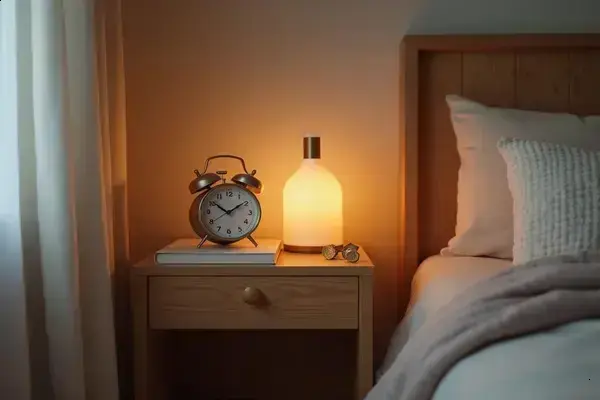
- Dimmable bedside lamp or smart plug for lights-down fade.
- White noise machine for sound masking.
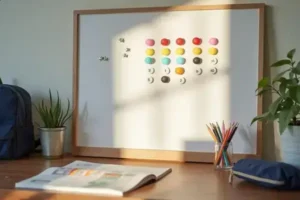
- Magnetic or laminated visual routine chart for cueing.
- Blackout curtains to stabilize darkness year-round.
- Timer (phone or kitchen) to end bath and reading calmly.
- Small water bottle by the bed to prevent get-ups.
Picture this scenario: Tuesday, 7:35 p.m., your lamp shifts to warm, the timer chimes, and your child points at the next icon on the chart. No debate — just the next step.
The Sequence (35–45 minutes total)
- Transition Cue (2 min): Switch to warm light and soft music. Say, “Evening steps start now.” This lowers arousal without a power play.
- Bath or Wash-Up (8–10 min): Warm water relaxes; skip if it wakes your child. Quick face wash works too.
- Teeth + Bathroom (5 min): Keep flossers visible. One bathroom trip now prevents “I have to go” later.
- Prep For Tomorrow (3 min): Lay out pajamas and tomorrow’s outfit — reduces morning stress and bedtime bargaining.
- Calm Play Or Stretch (5 min): Puzzles, drawing, or gentle stretches. No roughhousing; you’re steering cortisol down.
- Story Time (8–12 min): Same chair, same tone. Choose 1–2 books, then close with a predictable last line.
- Lights Down + White Noise (1 min): Dim to nightlight or full dark. Start the sound machine; it becomes the sleep cue.
- Bedtime Script (1–2 min): Tuck-in phrase: “I’m right outside. See you in the morning.” Leave confidently — brief, warm, consistent.
In practice: most families stabilize within 5–7 nights when the order stays solid and the voice stays calm — even if bedtime slides during travel or sports nights.
And honestly? The sequence works — until stalling starts. And this is exactly where most people make the most common mistake…
Handling Bedtime Resistance Without Power Struggles
Bedtime pushback isn’t random — it’s communication. Kids resist when they’re overtired, under-connected, or unsure what happens next. Your job isn’t force; it’s clarity and calm control.
Here’s the thing: power struggles spike cortisol and stretch sleep latency. The American Psychological Association notes that predictable routines and positive reinforcement reduce oppositional behavior far better than threats.
Picture this scenario: it’s 8:10, lights are warm, and your child asks for “one more book.” You validate, offer a simple choice, and point to the next step on the visual chart. No lecture — just momentum.
| Behavior | Likely Driver | Low-Conflict Response |
|---|---|---|
| Endless requests | Connection-seeking | Offer 2 fixed choices; mirror feeling; move on |
| “I’m not tired!” | Second wind/overstimulation | Dim lights, quiet voice, reduce stimuli immediately |
| Leaving bed | Boundary-testing | Return calmly with one-sentence script, zero debate |
💡 Pro Tip: Try a “bedtime pass.” Give one tangible pass per night. Child may trade it for water or a hug, then it’s done. Studies in the Journal of Pediatric Psychology show passes reduce curtain calls and tantrums without escalating conflict.
De-escalation Playbook (5 Minutes, Max)
- Label and limit: “You want another story — tonight we do two.” Short, warm, final.
- Choice within routine: “Hug now or after lights?” Ownership lowers resistance.
- One-sentence return: “It’s bedtime; back to bed.” Repeat neutrally each time.
- Positive drift: Whisper a calming cue — slow breathing or a favorite line.
- Reward tomorrow: Sticker or token economy for staying in bed all night.
In practice: many families see a 30–50% drop in “curtain calls” within a week when they use one script, one pass, and the same order nightly.
- Use a transition object (soft toy) to bridge separation.
- Keep white noise steady to mask household sounds.
- Log wins; consistency pays more than intensity.
Worth noting: the American Academy of Pediatrics supports consistent limits and calm, brief check-ins — not lengthy negotiations — to protect sleep quality and next-day mood.
What actually works might surprise you — the right printable routine cards and age-tuned visuals make these responses automatic…
Printable Bedtime Routine Charts By Age Group
You don’t need fancy apps — a clear, visual chart kids can touch works best. Here’s the thing: visibility + consistency beats reminders every time.
Each printable should show the fixed sequence, a check-off area, and a simple reward tracker (stars or tokens). Keep it at eye level and update once daily.
💡 Pro Tip: Print on heavy stock, then laminate and use a wet-erase marker — durable, smudge-free, and perfect for quick resets after travel or illness.
In practice: your preschooler taps each icon — bath, brush, book, bed — and colors one star at the end. You say the same tuck-in line. No debate; just progress.
| Age Group | Core Steps On Chart | Reward/Notes |
|---|---|---|
| Toddlers (1–3) | Bath → Diaper/PJs → Brush → Book → Bed | 1 big sticker for all steps; minimal text, big icons |
| Preschool (3–5) | Wash-Up → PJs → Brush/Floss → Story → Lights | Star chart to 10 = small prize; add “bath optional” tile |
| Grades (6–9) | Shower → PJs → Teeth → Backpack Ready → Read → Lights | Weekly points for bedtime independence; include time boxes |
How To Use And Customize
- Place the chart where your child starts the routine — bathroom door or nightstand — at kid eye level.
- Use icons plus short words for pre-readers; add time blocks (5–10 mins) for early grades.
- Let kids choose one element (book or pajamas) to boost buy-in; ownership reduces stalling.
- Mark progress right away, then celebrate at lights-out — tiny dopamine bump locks the habit.
- Refresh the reward every 1–2 weeks; novelty matters more than cost in a token economy.
Worth noting: the American Academy of Pediatrics supports predictable routines and positive reinforcement; visual schedules make the routine concrete, which improves follow-through on busy nights.
The truth is, a printable turns “nagging” into a simple system — and when the system runs, bedtime feels human again. Once this is in place, the rest of the routine falls into place naturally.
Calmer Nights Start Tonight
You’ve got the tools that matter: the sleep science behind cues, age-based hours from the National Sleep Foundation, and a step-by-step sequence that avoids power struggles. Add visual charts to lock habits in. If you take just one thing from this guide, let it be: routine beats perfection—use a bedtime routine for kids printable to make calm nights repeatable.
Before, nights felt random — stalling, late lights, grumpy mornings. Now you can set the right bedtime, follow a simple order, and use one calm script. Less noise. More signals. Your home gets quieter, and your kid falls asleep faster because the cues finally line up.
Which single change will you try first — the fixed sequence, the bedtime pass, or the printable chart? Tell us in the comments!

About the Author: Stephanie Lynn Barrett is a homeschooling mom, educational writer, and the founder of this blog — built for parents who want to give their children the best possible learning experience at home without burning out in the process.
After years of homeschooling her own children, testing every curriculum approach, building and rebuilding daily schedules, and creating hundreds of hands-on activities from scratch, Stephanie realized that most of the resources available online were either too complicated, too expensive, or too generic to be genuinely useful for real families with real kids.
So she started creating her own — practical lesson plan templates, age-appropriate activity ideas, printable routine charts, and honest curriculum guides designed for parents who are figuring it out as they go.
Stephanie is not a certified teacher or child psychologist — just a dedicated homeschooling parent who has spent years in the trenches, learning what works and what doesn’t, and turning every hard-won lesson into content that saves other parents time, stress and second-guessing.
Every article on this site is researched using trusted educational sources including the American Academy of Pediatrics, the American Library Association, the Home School Legal Defense Association, and the American Psychological Association — so you always get guidance that is practical, age-appropriate and grounded in real child development research.
When she’s not writing or planning next week’s lessons, Stephanie is testing new sensory play ideas with her youngest, hunting for the perfect read-aloud for her oldest, and convincing her family that yes, math can actually be fun.