Shoes vanish, toothpaste explodes, someone can’t find the backpack — and the clock won’t stop. Sound familiar? In that chaos, a kids morning routine checklist printable starts to feel like a lifeline.
Mornings are the day’s sharpest turn. When there’s no clear path, tiny stalls stack up — one spilled cereal, one lost permission slip — and everyone’s stress spikes. You’re late, your kid melts down, and the ride to school is tense before you’ve had a sip of coffee.
By the end, you’ll have a simple night-before plan, a step-by-step morning flow, a visual checklist for non-readers, and age-specific scripts for pushback. You’ll also get a ready-to-use kids morning routine checklist printable. Take a breath — the next section sets you up tonight.
Why Mornings Feel So Hard: The Highest-Stress Transition
Why do mornings feel like the boss level of parenting? Here’s the thing: your child’s brain is waking while the clock is racing — sleep inertia (that heavy, groggy window after waking) collides with urgent decisions and a hard deadline.
Picture this scenario: it’s 7:12 AM, the bus comes at 7:30, and the backpack zipper jams. You ask a simple question — “Did you brush?” — and boom, tears. It’s not defiance. It’s cognitive overload stacked on low blood sugar and missing cues.
Left unsolved, tiny stalls compound into real costs: late slips, tense car rides, and a rough first class. The Centers for Disease Control and Prevention notes that inadequate sleep and rushed mornings hurt attention and mood in school-age kids. Stress lingers — for you, too.
💡 Pro Tip: Shift wake time earlier by 10–15 minutes for three days and bring in light fast. The American Academy of Pediatrics says school-age kids need 9–12 hours; steady sleep plus morning light shortens grogginess.
Top Morning Stressors And Fast Fixes
| Morning Stressor | Why It Hits Hard | Low-Lift Fix |
|---|---|---|
| Sleep Inertia | Brain lag slows processing for 15–45 minutes | Open curtains, bright kitchen lights, calm first task (water + bathroom) |
| Decision Fatigue | Too many choices drain working memory fast | Pre-select outfit/snack the night before; limit to 2 options |
| Missing Items | Search time explodes when time is tight | Create a “launch pad” zone: backpack, shoes, water bottle only |
| Blood Sugar Dip | Low fuel = irritability and slow follow-through | Front-load quick carbs + protein: yogurt, banana, or toast + peanut butter |
| Transition Anxiety | Switching from cozy to go-mode spikes resistance | Use a predictable cue: timer sound, same song, or visual checklist |
Worth noting: if morning meltdowns persist for weeks, or you suspect sleep apnea or anxiety, talk with your pediatrician for individualized guidance.
- Hidden friction: clocks that don’t match — sync phone, oven, and alarm.
- Hidden friction: no clear handoffs — who packs lunch, who warms the car?
- Hidden friction: noisy first minutes — reduce chatter until everyone’s awake.
And honestly? What actually works might surprise you…
The Night-Before Setup That Cuts Stress In Half
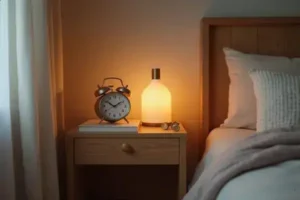
What if tomorrow’s calm starts tonight? Here’s the thing: evenings are quiet — and that’s when you can strip away the tiny frictions that explode at 7:15 AM.
Why does this work so well? Decision fatigue and weak “executive function” — the brain’s planning and switching system — peak under time pressure. At night, you’ve got space to pre-load choices.
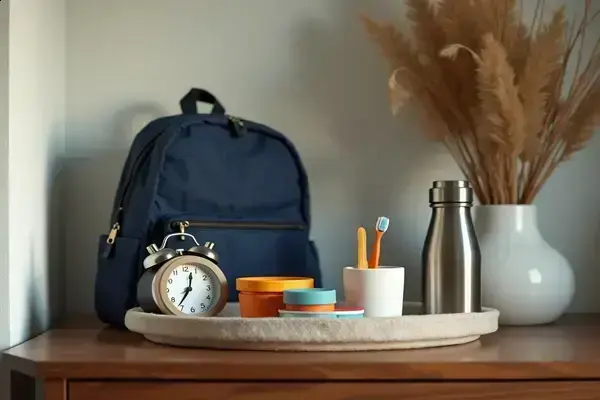
In practice: at 8:05 PM, you set a 10-minute timer, stage a small launch pad by the door, and pre-pack the backpack and lunch. You save 12 minutes and three arguments by morning.
💡 Pro Tip: Keep the launch pad within two steps of the exit. The Sleep Foundation notes predictable pre-sleep routines improve next-day alertness; extend that predictability to your morning gear to reduce last-second scrambling.
Your 10-Minute Night-Before System
Start simple, then refine. You’ll feel the difference on day one — and even more by day three.
- Labeled tray or shallow basket
- Two wall hooks or a sturdy peg
- Clear bin for shoes
- Dry-erase marker + plastic sleeve for a printable
- Stainless water bottle and sealed lunch container
- Do a 2-minute sweep: backpack to hook, shoes to bin, jacket on second hook.
- Pack the backpack: homework folder, library book, activity gear — zip fully.
- Pre-stage food: fill the water bottle; place lunchbox in fridge, lids on.
- Lay out clothes top-to-toes: underwear to socks, including hair ties or belt.
- Check the weather and adjust outfit — avoid morning rethinks.
- Place keys, ID card, and transport pass in the tray. Non-negotiable home spot.
- Set a visual checklist in the plastic sleeve; kids can tick with dry-erase in the morning.
| Night-Before Task | Time Saved AM | Stress Impact |
|---|---|---|
| Clothes Laid Out | 3–5 minutes | Eliminates outfit debates |
| Backpack Fully Packed | 4–6 minutes | Prevents frantic item hunts |
| Lunch + Water Ready | 3–4 minutes | Removes early-morning kitchen chaos |
| Keys/Pass on Tray | 1–2 minutes | Kills last-doorway panic |
Worth noting: the Child Mind Institute recommends offering two choices to build autonomy — let your child pick between two outfits or snacks to reduce pushback.
And honestly? What actually works might surprise you — the morning sequence hinges on one subtle order most parents get backward…
Step-By-Step Morning Sequence That Actually Works
You don’t need a perfect morning — you need a predictable one. Here’s the thing: order matters more than speed, and tiny wins stack fast.
Total time: 35–45 minutes door-to-door. Prerequisites: night-before setup done, wake time set, single sound cue ready (song or timer).
- Visual timer or small analog clock
- Smart speaker playlist or single morning song
- Silicone bib + linen napkin
- Insulated water bottle pre-filled
- Magnetic routine board or laminated printable with dry-erase
Your Morning Flow In 8 Steps
- Wake + Light On (2 min): open curtains, lights up, one calm “good morning.” No questions yet — let brains boot up.
- Hydrate + Bathroom (4 min): sip water, toilet, wash hands, quick face splash to reduce sleep inertia.
- Micro-Move (1 min): 30 seconds of stretches or two goofy jumps; it nudges alertness without chaos.
- Breakfast First (8–10 min): quick carb + protein combo — yogurt and banana, toast with peanut butter, or eggs. The Academy of Nutrition and Dietetics notes balanced breakfasts support attention and memory.
- Brush Teeth After Eating (2–3 min): wipe mouth, then brush. If citrus or juice was served, the American Dental Association suggests waiting a bit after acidic foods.
- Get Dressed (5 min): clothes were staged; offer two choices to cut decision fatigue.
- Launch Pad Check (2–3 min): backpack zipped, water bottle in, jacket ready — use the visual checklist, not your voice.
- Shoes, Jacket, Out-The-Door Buffer (5 min): set a 3-minute cushion to absorb surprises.
💡 Pro Tip: Use one specific song as a timing anchor — when the chorus hits, breakfast starts; by the bridge, teeth are brushed. Consistent audio cues reduce verbal nagging and speed transitions.
In practice: your 6-year-old starts sleepy. You say nothing, hit the same song, slide water over, and point to the board. Ten minutes later, breakfast’s done — no debate, just rhythm.
The truth is, the “breakfast-before-getting-dressed” switch prevents stains and arguments — a tiny reorder with outsize payoff. But there’s one detail most families overlook until it’s too late: the visual cues that do the reminding for you…
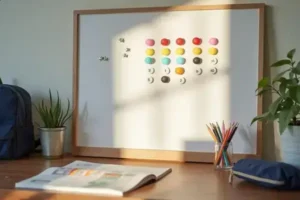
Visual Checklist For Non-Readers: Icons, Colors, And Cues
If your kid can’t read yet, words are noise at 7 a.m. Pictures, colors, and consistent cues do the heavy lifting — fast and calm.
Here’s the thing: non-readers process visuals quicker than verbal lists under pressure. A picture-first routine chart reduces negotiations and keeps transitions predictable.
In practice: your 4-year-old spots a toothbrush icon in blue, a shirt icon in green, and a bowl icon in yellow. You don’t narrate; you point, nod, and let the chart lead.
💡 Pro Tip: Keep one layout all week and align icons left-to-right at your child’s eye level. The National Association for the Education of Young Children notes that consistent visual supports strengthen executive functioning and self-regulation in early learners.
Build The Picture-First Checklist
- Pick 5–7 core tasks only — fewer choices, faster flow.
- Choose clear icons (toothbrush, shirt, bowl, backpack, shoes) with bold outlines.
- Color-code by category: blue = bathroom, green = get dressed, yellow = eat, red = go.
- Mount at kid height on a magnetic board or rigid surface.
- Add a tactile cue: flip card, slide magnet, or checkmark with dry-erase.
- Rehearse once at night — 60 seconds is enough to prime memory.
- In the morning, point-don’t-ask. Let the visual schedule, not your voice, set pace.
| Format | Pros | Trade-Offs |
|---|---|---|
| Magnetic Board | Tactile movement; easy reordering; durable | Wall space needed; magnets can get lost |
| Laminated Card Ring | Portable on backpack; flip-to-complete | Smaller visuals; needs hole-punch + ring |
| Picture Schedule App | Animated cues; timers; sound prompts | Device temptation; requires charging/settings |
Worth noting: use the same icon style and a single font for any numbers — mixed styles increase cognitive load and slow time-on-task.
- Blue bathroom cue: toothbrush icon + tiny water droplet.
- Green dressing cue: t-shirt icon facing front — no tags shown.
- Yellow breakfast cue: bowl + spoon with soft shadow.
- Red go-time cue: backpack + shoe print for momentum.
The truth is, fewer, bigger icons beat crowded boards — clarity wins. And this is exactly where most people make the most common mistake: they keep changing the order every day…
Solving Morning Resistance By Age: Toddlers, Grade-Schoolers, Tweens
Mornings don’t break the same way for every kid — resistance looks different at 3, 8, and 12. Here’s the thing: match your strategy to brain development, not your patience level.
Toddlers (2–4): They crave control but have limited impulse control. Offer two fixed choices, use first–then language, and anchor everything to pictures. Keep tasks bite-size — 60 to 90 seconds each works best.
Grade-schoolers (5–10): They can plan with support and respond well to concrete time-blocks. Create a simple “morning contract” with when–then rules: “When teeth are brushed, then breakfast.” Add a visual timer and let them check off steps for earned privileges, not bribes.
💡 Pro Tip: Use micro-scripts to cut debates: Toddler — “First shoes, then car song.” Grade-schooler — “Timer’s on; choose red or blue shirt.” Tween — “You own your alarm; I’m backup at 7:05.” Consistency beats volume every time.
Age-Smart Scripts That Defuse Pushback
Tweens (11–13): Circadian shifts make early wake-ups tough — their sleep drive skews later. The American Academy of Sleep Medicine notes adolescents still need 8–10 hours for mood and attention. Nudge bedtime earlier in 10-minute steps, and move light exposure earlier by opening curtains right away.
Picture this scenario: your 3-year-old stalls at shoes, your 8-year-old argues about shirts, and your 12-year-old snoozes through alarms. You point to icons for the toddler, hand the 8-year-old a two-choice card, and set a single song as the tween’s alarm. Three kids, three paths — one calm hallway.
Worth noting: grade-schoolers thrive on autonomy with guardrails — let them pack the backpack using a final “launch pad” check, then review only once. Tweens prefer agency plus natural consequences; if they miss the bus, they help plan an earlier alarm and pack at night.
In practice: one parent shifted lights-on five minutes earlier for a week, swapped nagging for a silent visual timer, and used habit stacking — drink water, bathroom, shoes, then backpack. Transitions dropped from 18 minutes to 9, and the tone changed first.
The right habits in place now make everything easier from here.
Your Mornings Just Got Lighter
Night-before setup, a simple morning sequence, and visual cues matched to age — that’s your new playbook. If you take just one thing from this guide, let it be: predictability beats speed. Use a kids morning routine checklist printable to make the order visible and the next step obvious.
Before, mornings felt like sprints through wet cement — missing shoes, slow starts, raised voices. Now you’ve got anchors. A launch pad by the door. One song as your metronome. Pictures doing the reminding, not you. Fewer decisions. More calm. Out the door on time.
Which will you try first — the launch pad, the single morning song, or the picture checklist — and why, in the comments?

About the Author: Stephanie Lynn Barrett is a homeschooling mom, educational writer, and the founder of this blog — built for parents who want to give their children the best possible learning experience at home without burning out in the process.
After years of homeschooling her own children, testing every curriculum approach, building and rebuilding daily schedules, and creating hundreds of hands-on activities from scratch, Stephanie realized that most of the resources available online were either too complicated, too expensive, or too generic to be genuinely useful for real families with real kids.
So she started creating her own — practical lesson plan templates, age-appropriate activity ideas, printable routine charts, and honest curriculum guides designed for parents who are figuring it out as they go.
Stephanie is not a certified teacher or child psychologist — just a dedicated homeschooling parent who has spent years in the trenches, learning what works and what doesn’t, and turning every hard-won lesson into content that saves other parents time, stress and second-guessing.
Every article on this site is researched using trusted educational sources including the American Academy of Pediatrics, the American Library Association, the Home School Legal Defense Association, and the American Psychological Association — so you always get guidance that is practical, age-appropriate and grounded in real child development research.
When she’s not writing or planning next week’s lessons, Stephanie is testing new sensory play ideas with her youngest, hunting for the perfect read-aloud for her oldest, and convincing her family that yes, math can actually be fun.