Backpacks on the floor, breakfast dishes in the sink, and you’re the only one hustling. Sound familiar? A quick fix — a chores for kids by age printable — can turn that daily standoff into a calm, shared plan.
The problem isn’t laziness; it’s unclear expectations. When jobs feel random, kids push back, you nag, and everyone ends up frustrated. Time slips, mornings spiral, and the constant arguing chips away at confidence — yours and theirs.
By the end, you’ll have age-specific chore lists from toddler to teen, simple scripts to avoid power struggles, expert-backed tips, and a chores for kids by age printable chart you can use tonight. Let’s start with why chores matter.
Why Chores Build Responsibility And Self-Esteem
Here’s the thing: chores aren’t busywork — they’re training for real life. Kids don’t just “help out.” They learn how to manage themselves.
Wonder why small tasks boost confidence? Mastery. When a child wipes a table well or sorts socks fast, the brain tags it as competence, and confidence follows. That’s the start of responsibility.
💡 Pro Tip: The American Academy of Pediatrics notes that predictable, age-appropriate chores support executive function — planning, working memory, and self-control — when paired with clear expectations and calm follow‑through.
Picture this scenario: your 6-year-old feeds the dog every evening. At first, you remind them — a lot. Two weeks in, they check the chart, measure the scoop, and call you over to show the empty bowl. That tiny “I did it” moment stacks, day after day.
Evidence Snapshot
Research from the University of Minnesota (Marty Rossmann’s longitudinal study) found that children who start chores by ages 3–4 are more likely to have stronger relationships, higher academic success, and better self-management later.
| Skill Built | Chore Example | Confidence Driver |
|---|---|---|
| Executive Function | Set the table nightly | Sequencing and routine mastery |
| Accountability | Feed pets on schedule | Visible outcome; living being relies on them |
| Self‑Efficacy | Make bed each morning | Quick win to start the day |
| Teamwork | Sort laundry by color | Shared goal with measurable progress |
And the psychology? Three levers matter: autonomy (kids choose when/how within limits), competence (tasks they can actually master), and relatedness (they feel useful to the family). That’s Self‑Determination Theory in kid-size form.
- Use a visual tracker — a simple chores for kids by age printable — to make progress obvious.
- Pair effort with labeled praise: “You remembered the timer — that’s planning.”
- Keep rewards modest (stickers or extra reading time) so intrinsic motivation grows first.
Worth noting: if you’re navigating neurodiversity or behavior challenges, a pediatrician or licensed child psychologist can tailor routines and supports.
What actually works might surprise you — the next step is choosing the right chore by age and framing it so your child says “I’ve got this,” not “Do I have to?”
Age-By-Age Chore Lists: Toddler, Preschool, Elementary, Tween, Teen
You want the right chore at the right age — not too easy, not too hard. That sweet spot builds momentum fast.
How do you match chores to ability without guesswork? Use this clear grid, then plug it into a chores for kids by age printable you can update weekly. Setup: 20 minutes. Daily upkeep: 5 minutes.
| Age Group | Daily Chores | Weekly Chores |
|---|---|---|
| Toddler (2–3) | Place toys in bin; wipe small spills with cloth | Match socks; water one plant with help |
| Preschool (4–5) | Make bed loosely; feed pets with measured scoop | Dust low shelves; sort laundry by color |
| Elementary (6–8) | Clear dishes; empty small trash; set table | Fold towels; vacuum a small area |
| Tween (9–12) | Load dishwasher; sweep kitchen; tidy desk | Wash/dry simple loads; take out trash |
| Teen (13–17) | Plan one simple dinner; manage calendar reminders | Deep-clean bathroom; grocery mini-run with list |
In practice: your 5-year-old picks “feed the dog” and “make the bed.” You model once, co-pilot twice, then watch. Three days later, they point to the chart first — not you.
- A printed or laminated chores for kids by age printable
- Kid-sized tools (step stool, small broom, labeled bins)
- Visual timer (5–15 minutes) and simple stickers or gold coin tokens
- Calm check-in time (evenings work best)
Quick Setup Steps
- Select 2–4 age-fit chores using the table; cap each at 10–15 minutes.
- Define the trigger: after breakfast, before screen time, or right after school.
- Use gradual release — “I do, we do, you do” — over three runs.
- Post the chart at your child’s eye level; give one cue, then start the timer.
- Close the loop: inspect, label the skill (“You sorted colors fast”), and mark the chart.
- Review weekly: swap one chore, increase difficulty slightly, and keep any allowance policy consistent (not pay-per-task).
💡 Pro Tip: The Centers for Disease Control and Prevention notes attention spans often track at 2–3 minutes per year of age; keep chores within that window. The American Academy of Pediatrics also recommends clear, consistent routines over perfection talk.
What actually works might surprise you — the way you introduce the first task matters far more than the task itself.
How To Introduce Chores Without Battles Or Bribes
You’re tired of tug‑of‑war over simple tasks — and you don’t want to pay kids for basic living. There’s a calmer path that sticks.
What’s the no‑drama approach? Design the routine, not the argument. Use small, clear cues, habit stacking, and positive reinforcement so cooperation feels automatic.
💡 Pro Tip: Anchor chores to existing habits using a simple “when–then” rule: “When the backpack is on the hook, then snack happens.” The Harvard Center on the Developing Child notes that predictable routines strengthen executive function — the mental skills kids use to plan, focus, and follow through.
Steps That Prevent Power Struggles
- Set the frame in a 5‑minute family huddle. Say what’s changing, why it matters, and how you’ll help — no lectures, just clarity.
- Pick 2 age‑fit chores per child and timebox each to 10–15 minutes. Keep the first week easy to build early wins.
- Create a visual schedule. Post a chores for kids by age printable at eye level; add icons or color codes so kids don’t need reminders from you.
- Teach with gradual release. Do one demo, co‑do once, then step back. Offer a single calm cue — not repeated prompts that become noise.
- Use “when–then,” not bargaining. “When the table is set, then screens start.” Avoid if‑then bribes that shift focus to payout over pride.
- Close the loop with labeled praise. Name the skill — “You checked the list without me; that’s independence.” This boosts intrinsic motivation, not just token economy buzz.
- Review weekly. Swap one task, raise difficulty slightly, and keep any allowance policy consistent and separate from core chores.
In practice: your 8‑year‑old has “unpack backpack” and “set the table.” You point once to the chart, start a 10‑minute timer, and step away. By Thursday, they trigger the routine themselves — because the cue lives on the wall, not in your voice.
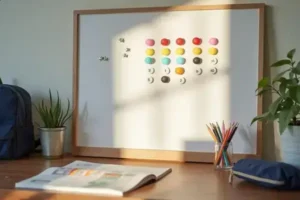
- Magnetic or laminated chore chart with icons
- Visual timer (5–15 minutes)
- Kid‑sized tools: step stool, small broom, labeled bins
- Gold coin tokens or stickers for streaks (optional)
And this is exactly where most people make the most common mistake — they add more reminders instead of improving the cue and the first 60 seconds of the routine.
Printable Weekly Chore Chart: Template, Rewards, And Routines
You don’t need a perfect system — you need a weekly one that runs without your voice. A printable chart makes the routine visible and fair.
What does a strong template include? Clear slots for daily tasks, streak tracking, simple rewards, and a quick weekly reset. Think habit tracker, not nag list.
Template At A Glance
| Reward System | Best For | Watch Out |
|---|---|---|
| Sticker Streaks | Young kids who love visuals | Keep targets tiny; avoid endless stickers |
| Gold Coin Tokens | Tweens who like saving/spending | Pair with clear menu; no moving goalposts |
| Allowance Policy | Teens learning budgeting | Separate core chores from paid extras |
- Laminated weekly chore chart or a chores for kids by age printable
- Dry‑erase markers, color‑coded magnets, or tokens
- Visual timer and small caddy for tools
- Short reward menu (experiences beat trinkets)
Fill‑And‑Use Setup
- Write 2–4 age‑fit chores per child across Mon–Sun; cap each task at 10–15 minutes.
- Assign triggers — after breakfast, before screens, or right after homework.
- Define success criteria in kid language: “Bed smooth, pillow on top.”
- Choose a reward path: sticker streak (5 in a row), 1 token per day, or a flat weekly allowance tied to participation only.
- Post the chart at eye level; one cue, then start the timer. You inspect, they mark.
- Run a 10‑minute Sunday reset: swap 1 task, update rewards, and celebrate streaks.
💡 Pro Tip: The Child Mind Institute highlights that visual schedules reduce conflict by shifting reminders from parents to the environment. The American Psychological Association notes immediate, labeled praise outperforms vague “good job” for building intrinsic motivation.
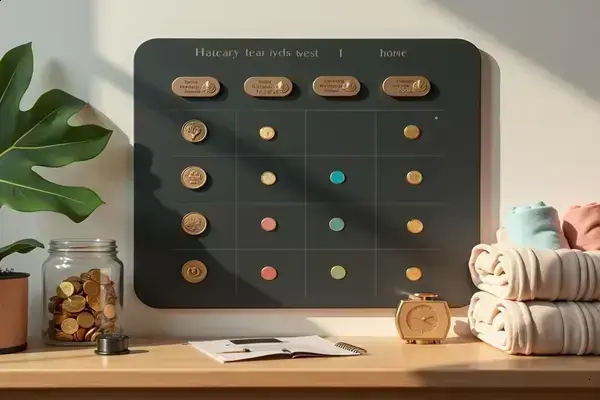
In practice: your 10‑year‑old has “dishwasher load” and “room reset.” Each day, they check boxes, drop one gold coin in the jar, and circle Sunday for a family game once five coins stack — clean, predictable, drama‑free.
The truth is, the printable isn’t magic by itself — the first 60 seconds of the routine decide follow‑through. And this is exactly where most people make the most common mistake…
What Child Development Experts Recommend At Each Stage
What should kids actually do at each age? Experts converge on a simple idea — match tasks to developing skills so confidence grows, not cracks.
Stage-by-Stage Guidance
Toddlers (2–3) thrive on imitation and single-step jobs. Think cause-and-effect actions you can model hand-over-hand, then fade help. Zero to Three emphasizes co-regulation and short routines; so “put toy in bin” beats anything needing complex sequencing.
Preschoolers (4–5) can handle two-step directions and light responsibility. Offer choice within limits — “wipe table or water plant” — and keep tools sized right. The American Occupational Therapy Association notes that fine-motor practice (small spray bottle, cloth squeeze) builds coordination and self-reliance.
Elementary kids (6–8) are ready for checklists and time boxes. You’ll see working memory stretch — so post visible cues and define “done” in kid language. CASEL’s social-emotional learning framework highlights autonomy and competence; a clear start-and-finish (“set table: mats, forks, cups”) turns effort into mastery.
Tweens (9–12) need ownership, not micromanagement. Shift to project chores: full laundry cycles, simple meal planning, and room resets with a timer. Cooperative Extension programs often pair these with budgeting mini-tasks (compare unit prices) to connect household work with real-world decision-making.
Teens (13–17) step into life skills with safety and quality standards. Assign weekly bathroom deep cleans, pantry audits, and one dinner from plan to plate — including cleanup. The CDC’s food safety guidance (clean, separate, cook, chill) is a smart baseline for any kitchen task.
💡 Pro Tip: Calibrate challenge using “one new demand at a time.” If you raise complexity (e.g., add timing), keep the environment stable (same tools, same order). Zero to Three and the American Occupational Therapy Association both stress consistency as the scaffold that lets skills stick.
In practice: your 11-year-old runs “Taco Tuesday.” They inventory ingredients, build a short list, prep with a thermometer check, and plate on time. You review quality, they log notes for next week — simple, safe, repeatable.
The right habits in place now make everything easier from here.
Chores That Actually Stick
You learned three things that matter most: chores build responsibility and self‑esteem when kids see mastery; age‑by‑age tasks plus a visual chart keep expectations clear; and calm routines with simple cues, time boxes, and labeled praise drive follow‑through. If you take just one thing from this guide, let it be: design the routine, not the argument — your chores for kids by age printable makes the plan visible and fair.
Before, every request felt like a standoff. You repeated yourself, and nothing stuck. Now you’ve got age‑fit chores, a weekly chart, and a first 60‑seconds playbook. Less nagging. More ownership. Kids check the board, start the timer, and you inspect once. Small wins stack. Confidence grows.
Which part will you put in place this week — the age list, the visual chart, or that first 60‑second cue? Tell us in the comments!

About the Author: Stephanie Lynn Barrett is a homeschooling mom, educational writer, and the founder of this blog — built for parents who want to give their children the best possible learning experience at home without burning out in the process.
After years of homeschooling her own children, testing every curriculum approach, building and rebuilding daily schedules, and creating hundreds of hands-on activities from scratch, Stephanie realized that most of the resources available online were either too complicated, too expensive, or too generic to be genuinely useful for real families with real kids.
So she started creating her own — practical lesson plan templates, age-appropriate activity ideas, printable routine charts, and honest curriculum guides designed for parents who are figuring it out as they go.
Stephanie is not a certified teacher or child psychologist — just a dedicated homeschooling parent who has spent years in the trenches, learning what works and what doesn’t, and turning every hard-won lesson into content that saves other parents time, stress and second-guessing.
Every article on this site is researched using trusted educational sources including the American Academy of Pediatrics, the American Library Association, the Home School Legal Defense Association, and the American Psychological Association — so you always get guidance that is practical, age-appropriate and grounded in real child development research.
When she’s not writing or planning next week’s lessons, Stephanie is testing new sensory play ideas with her youngest, hunting for the perfect read-aloud for her oldest, and convincing her family that yes, math can actually be fun.