
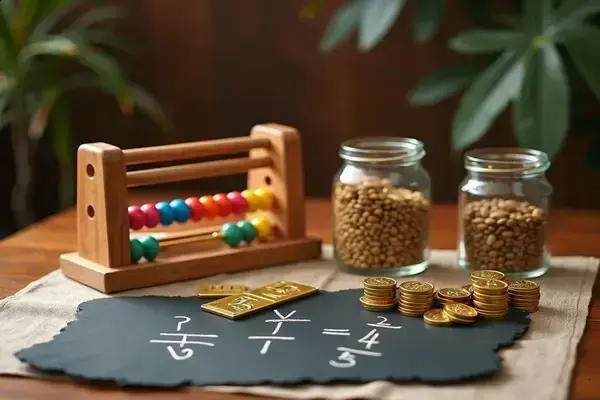
It’s 5:30 p.m.—dinner’s bubbling, homework’s half-done, and the wiggles are real. You want math activities for kids at home that actually work, not another screen. Grab a muffin tin, coins, and blocks; we’ll turn your table into a mini math lab.
When math stays abstract, kids tune out—and you’re stuck nagging, buying workbooks, or paying for apps that don’t stick. The cost isn’t just money; it’s confidence slipping away, day by day. You deserve easy ideas that fit real life and actually build number sense.
By the end, you’ll have grab-and-go setups for addition, subtraction, multiplication arrays, and “see-it” fractions, plus everyday scripts and printable game packs. We’ll start concrete—hands, objects, movement—then bridge to symbols with clarity. Your guide to math activities for kids at home starts now. Ready to flip open the first hands-on setup?
Make Math Concrete: Hands-On Addition And Subtraction
Kids learn faster when they can touch the math. Here’s the thing: addition and subtraction click when numbers become beans, blocks, and coins—real objects you can move. Start concrete, then shift to symbols with calm, clear steps.
Why does this work so well? The Concrete–Representational–Abstract (CRA) model builds number sense first, then fluency. Ten-frames, number bonds, and fact families aren’t buzzwords—they’re simple structures that help your child see how parts make a whole.
💡 Pro Tip: According to the National Council of Teachers of Mathematics, consistent use of manipulatives improves conceptual understanding and long-term fact fluency when paired with brief retrieval practice.
Picture this scenario: your child rolls a 7, drops 3 blue counters into a muffin cup, then adds 4 red ones. You label it 3 + 4 = 7, then flip it—7 − 3 = 4. The colors show “what’s left,” not just a number on a page. Confidence rises, and so does accuracy.
| Manipulative | Best For | Quick Win |
|---|---|---|
| Coins or Beans | Counting on/back, making 10 | Show 8; add 2 more; rename as a clean 10 |
| Muffin Tin (12 cups) | Ten-frames, fact families | Split 9 into 5 and 4; write both equations |
| Number Line (tape) | Jump strategy, difference | Start at 13, hop back 4; land at 9 |
Quick Setup: Muffin-Tin Fact Families
Time: 10 minutes. Ages: 5–9. Prerequisite: can count to 20.
- Muffin tin (or egg carton)
- 20 counters (beans, buttons, or coins)
- Sticky notes and marker (0–10)
- One die (optional)
- Label two cups with a target number (like 7) and a blank.
- Place 7 counters in the target cup; move some to the blank cup.
- Ask: “How many stayed? How many moved?”
- Write both additions (3 + 4 = 7; 4 + 3 = 7).
- Flip to subtraction (7 − 3 = 4; 7 − 4 = 3).
- Repeat with new splits; roll a die to randomize.
Worth noting: brief sprints (5–8 minutes) beat long drills. Do a quick formative check—ask your child to explain “why” before moving on.
But there’s one detail most parents overlook until it’s too late—the order you present numbers can make or break fluency…
Build Multiplication Sense With Arrays, Skip-Counting, And Groups
Multiplication sticks when kids see structure. Here’s the thing: arrays, equal groups, and skip-counting turn “times” into patterns you can touch, move, and explain out loud.
Worried about memorizing facts too soon? Build multiplicative reasoning first—seeing 3 groups of 4 as 12, then also 4 groups of 3 as 12 (that’s the commutative property, same product, flipped factors). Arrays also prep kids for the area model they’ll meet later.
💡 Pro Tip: The National Council of Teachers of Mathematics and Stanford’s youcubed note that visual models paired with brief retrieval practice boost retention and transfer—think 5-minute, high-frequency sprints over long drills.
| Method | Best For | Anchor Move |
|---|---|---|
| Arrays (grid/bricks) | Commutative thinking, area sense | Build 3×4 and rotate to 4×3 |
| Equal Groups | Early multiplication, counting accuracy | Make 5 groups of 2; recount by 5s |
| Skip-Counting Line | Fluency, bridging to division | Mark jumps of 3; land on 3,6,9,12 |
Array Builder Sprint
Time: 8–12 minutes. Ages: 6–9. Prerequisite: solid counting to 100.
- Interlocking bricks or tiles (at least 30)
- Small grid mat or graph paper
- Dot stickers and a marker
- Tape number line (0–30)
- Pick two factors (like 3 and 4). State the target: “We’re building 3 rows of 4.”
- Place bricks on the grid—3 neat rows, 4 per row. Touch and count: 4, 8, 12.
- Rotate the array. Ask: “What changed? What stayed?” Label 4×3.
- Represent it: draw the array; circle a row; write 3×4 = 12 and 4×3 = 12.
- Jump it: on the number line, make three jumps of 4. Say the totals out loud.
- Assess quickly: show 2×6, 6×2, and ask which is “easier” and why (strategy talk).
In practice: your child builds a 2×5 rectangle with tiles, then slides in one more column—now it’s 2×6. You say, “We added a 2.” They nod, “It’s 10 plus 2—12.” That’s distributive reasoning, anchored in sight and touch.
Worth noting: short, consistent reps outperform marathon sessions for fact fluency, skill mastery, and curriculum-aligned assessment checkpoints. What actually works might surprise you…
Fractions You Can See: Food, Paper Folding, And Measuring Cups
Fractions make sense when kids can see them. Here’s the thing: halves, thirds, and quarters stop being scary when they become food, folds, and fluid you can pour.
What’s the fastest bridge from confusion to clarity? Start with unit fractions (1/n), then build to equivalence using real anchors—1/2, 1/4, 3/4—so your child compares to something familiar. This aligns with the Common Core State Standards (CCSS-M) emphasis on fractions as numbers on a number line.
💡 Pro Tip: CCSS-M and the Institute of Education Sciences highlight that concrete-to-visual progressions (manipulatives → drawings → symbols) improve retention and transfer—keep each stage brief but consistent.
Picture this scenario: you slice a pita into four equal wedges. Your child eats one and says, “I had one piece.” You reply, “One of four equal parts—that’s 1/4.” Then two wedges together? “That’s 2/4, which equals 1/2.” The language pairs with the action, so it sticks.
| Method | Builds | Quick Check |
|---|---|---|
| Food (pita, apples) | Equal parts, equivalence | Show 2/4 and ask if it’s 1/2 |
| Paper Folding | Precision, symmetry, naming | Fold to 1/8; label each part |
| Measuring Cups | Addition of fractions | Make 1 cup using 1/3s or 1/4s |
5-Minute Measuring-Cup Equivalency Lab
Time: 5–8 minutes. Ages: 7–10. Prerequisite: reads simple fractions.
- Measuring cups (1, 1/2, 1/3, 1/4)
- Clear bowl or cylinder
- Dry beans or water (easy to pour)
- Sticky notes and marker
- Place the 1-cup measure by the bowl—this is your “whole.”
- Ask: “How many 1/2 cups make a whole?” Pour two 1/2 cups to prove it.
- Repeat with 1/4: pour four 1/4 cups. Label 1/4 + 1/4 + 1/4 + 1/4 = 1.
- Test 1/3: pour three 1/3 cups; discuss small over/under if your set isn’t perfect—measurement error is real life.
- Mix it up: make 1 cup using 1/2 + 1/4 + 1/4. Say the math out loud.
- Transfer to drawings: sketch a bar, partition, and label each pour as a fraction.
Worth noting: quick, messy reps beat pristine worksheets for concept growth, especially when kids state the fraction as they act—this is retrieval plus motor memory.
And this is exactly where most people make the most common mistake—naming the top number first without checking if the parts are actually equal…
Turn Everyday Moments Into Natural Math Lessons At Home
Real life is a math lab hiding in plain sight. Here’s the thing: when you turn chores, meals, and play into tiny math chats, skills grow without pushing—just noticing and naming.
What should you focus on first? Estimation, comparison, and quick mental strategies. They’re low-prep, curriculum-aligned, and they fit into moments you already have, like cooking pasta or timing a cleanup sprint.
💡 Pro Tip: The National Council of Teachers of Mathematics recommends frequent “math talk” in everyday contexts; brief prompts that ask kids to compare, estimate, or justify build number sense and confidence.
| Home Context | Skill Built | Quick Prompt |
|---|---|---|
| Cooking Dinner | Measurement, fractions | “We need 3/4 cup—what combo gets us there fast?” |
| Laundry Sort | Grouping, multiplication | “Make 4 piles of 3 socks; how many socks?” |
| Stair Climb | Skip-counting, patterns | “Count by 2s up the steps: where do you land?” |
| Toy Shelf | Data, categories | “Graph cars vs. animals—who wins today?” |
In practice: your child helps set the table with forks, spoons, and napkins. You say, “We’ve got five people—grab 2 forks each.” They count by twos, notice the pattern, and check the total. Zero worksheets, real reasoning.
2-Minute Math Talk Script
- Spot the moment (cooking, sorting, timing).
- Ask a compare or estimate prompt: “Which is more? By how much?”
- Have your child show or say their strategy.
- Probe once: “Why does that work?”
- Quick check: change one number and retry.
- Seal it with a label: “That’s smart estimation.”
Worth noting: micro-doses work. Two or three 90-second chats a day can outperform long drills for fluency, retention, and stress reduction—especially when you keep tone light.
And honestly? This flows best when your prompts are ready to grab. But there’s one detail most parents overlook until it’s too late—how a simple printable system locks these moments into a routine…
Printable Math Games By Level: Ready-To-Use Sets And How To Play
If you’ve got two minutes and a printer, you can build a math station that actually gets used. Here’s the thing: leveled, reusable games beat worksheets because they’re fast, visual, and fun.
How do you keep it simple and standards-based? Sort by level, label the pouch, and rotate weekly—short cycles drive fluency and confidence without burnout.
| Level | Game Type | Skill Focus |
|---|---|---|
| K–1 | Ten-frame bingo, domino sums | Counting, make-10, early addition |
| Grades 2–3 | Array match, place-value spin | Multiplication facts, regrouping |
| Grades 4–5 | Fraction strips, number-line race | Equivalence, mixed-number ops |
In practice: you grab the “Grade 2” pouch before dinner. Your child spins 347, draws a card “+ 80,” and uses base-ten boards to regroup. Three rounds later—done, happy, confident.
- Ten-frame mats (dry-erase): rapid make-10 practice; refresh targets weekly.
- Array grid cards: match factors to arrays; add challenge with rotations.
- Place-value spinners + base-ten boards: add/subtract hundreds; mark carries and borrows.
- Fraction strips and equivalence puzzles: build 1/2, 1/4, 3/4 families; compare on a number line.
- Number-line race boards: skip-count, estimate, and land on targets; great for mixed-ability play.
- Word-problem cards (A/B/C levels): same context, scaled numbers for easy differentiation.
💡 Pro Tip: The National Council of Teachers of Mathematics and the Institute of Education Sciences report that short, frequent game-based practice with immediate feedback outperforms longer drills for fact fluency and strategy transfer.
Quick Start: Print-and-Play Routine
Time: 6 minutes setup. Ages: 5–11. Prerequisite: can read basic numbers.
- Print on cardstock; slide into page protectors for dry-erase reuse.
- Assemble by level in zip pouches labeled K–1, 2–3, 4–5.
- Set a 6–8 minute timer—one game, two rounds, rotate roles.
- Use one feedback line: “Explain your move.” Keep tone light.
- Record a quick win on a sticky note (date + skill).
- Rotate sets each week; repeat favorites monthly for spaced practice.
- Store pouches in a slim file box near the dinner table for easy grabs.
Worth noting: consistent, low-prep reps reduce decision fatigue and support progress monitoring for homeschool and RTI-style intervention at home. The right habits in place now make everything easier from here.
Math At Home, Made Simple
Hands-on tools make numbers click; tiny routines turn meals and chores into math talks; leveled print-and-play games keep practice fast and fun. If you take just one thing from this guide, let it be: start concrete, then move to visuals, then symbols—in short daily sprints. With these math activities for kids at home, you’ve got everything you need.
Before, math felt like nagging and guesswork. Now you’ve got simple setups, quick scripts, and a rotation that fits real life. Five to eight minutes. Most days. Less stress. More wins. Your child sees patterns, explains thinking, and actually enjoys practice.
Which will you try first tonight—muffin-tin fact families, an array sprint, or the 2-minute math talk? Tell us in the comments and share what you notice after the first week.

About the Author: Stephanie Lynn Barrett is a homeschooling mom, educational writer, and the founder of this blog — built for parents who want to give their children the best possible learning experience at home without burning out in the process.
After years of homeschooling her own children, testing every curriculum approach, building and rebuilding daily schedules, and creating hundreds of hands-on activities from scratch, Stephanie realized that most of the resources available online were either too complicated, too expensive, or too generic to be genuinely useful for real families with real kids.
So she started creating her own — practical lesson plan templates, age-appropriate activity ideas, printable routine charts, and honest curriculum guides designed for parents who are figuring it out as they go.
Stephanie is not a certified teacher or child psychologist — just a dedicated homeschooling parent who has spent years in the trenches, learning what works and what doesn’t, and turning every hard-won lesson into content that saves other parents time, stress and second-guessing.
Every article on this site is researched using trusted educational sources including the American Academy of Pediatrics, the American Library Association, the Home School Legal Defense Association, and the American Psychological Association — so you always get guidance that is practical, age-appropriate and grounded in real child development research.
When she’s not writing or planning next week’s lessons, Stephanie is testing new sensory play ideas with her youngest, hunting for the perfect read-aloud for her oldest, and convincing her family that yes, math can actually be fun.